
Stamped Concrete in Utah: Does It Survive Freeze-Thaw?
The Short Answer
Stamped concrete can absolutely hold up along the Wasatch Front, and plenty of it does. But it is less forgiving here than it is in a mild climate, because the same textured surface that makes it read as flagstone also gives water more places to sit. Whether a stamped patio still looks good in ten years comes down to three things: the mix that went in the truck, where the water goes, and what happens to the surface every February.
If you are weighing a stamped patio or driveway for a home in Sandy or anywhere across Salt Lake, Utah, and Davis counties, here is what actually decides the outcome.
What Stamped Concrete Actually Is
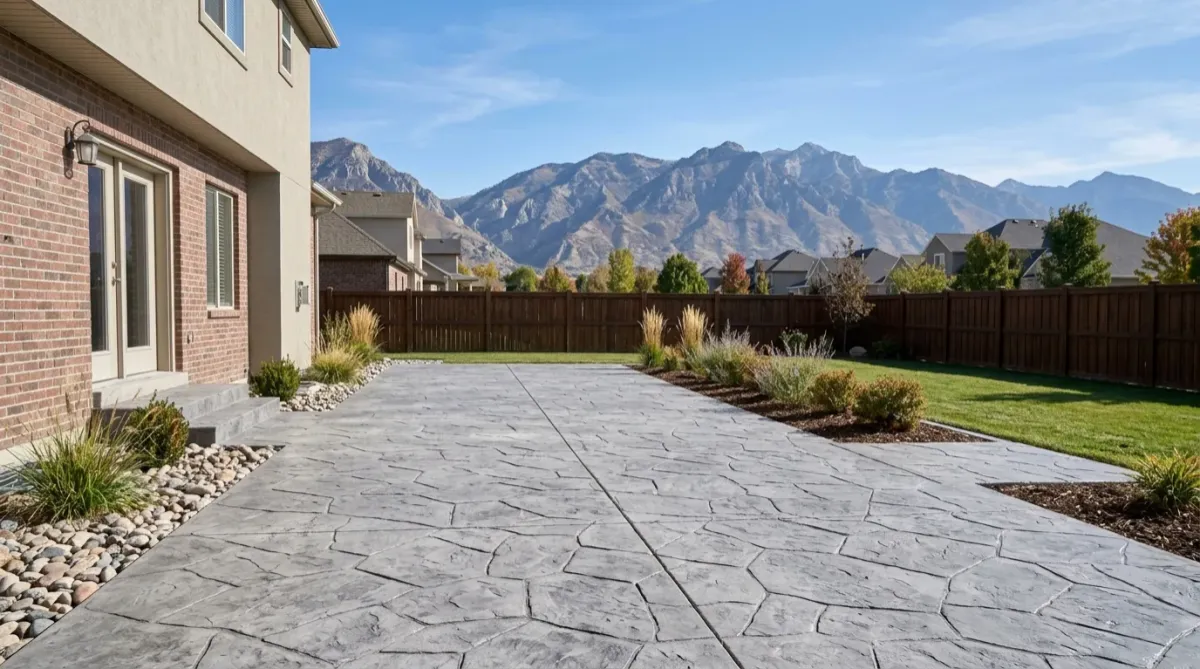
Stamped concrete is ordinary poured concrete pressed with textured mats while it is still plastic, so the finished slab reads as slate, flagstone, cobble, or wood plank. Color comes from pigment mixed through the batch, a dry color hardener broadcast onto the surface, or a release agent that leaves a secondary tone in the low spots of the texture. It is a finish decision rather than a different material, which is why it shows up on the same concrete patios and driveways as a plain broom finish.
That matters in two ways. The concrete underneath is only as good as its mix and prep, like any other slab. And the decorative layer lives in the top eighth of an inch, exactly the part a Utah winter attacks first.
Why Utah Winters Are Hard on Decorative Concrete
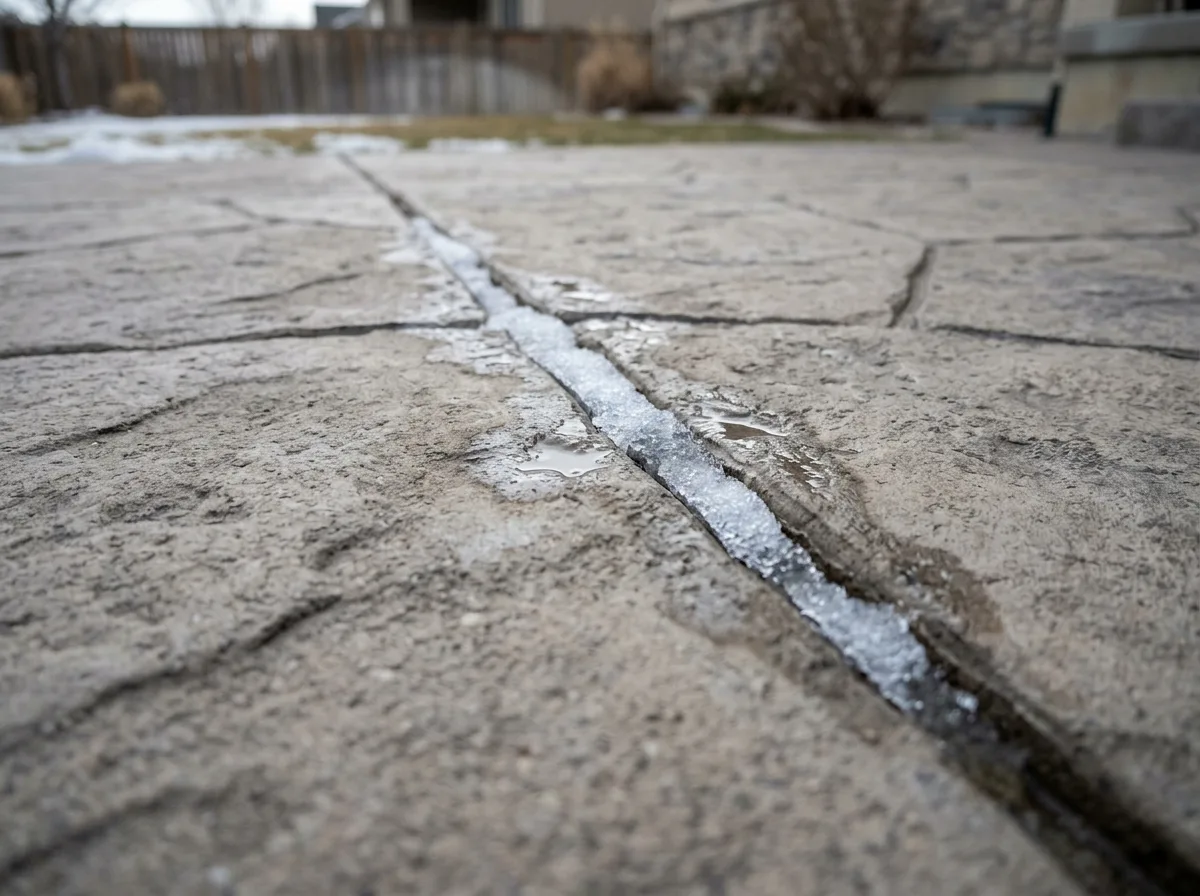
Freeze-thaw damage is mechanical, not chemical. Water works into the pores near the surface, freezes, expands by roughly nine percent, and pushes the top layer apart from the inside. Do it once and nothing happens. Do it a few dozen times over a winter, normal at valley elevations where afternoon sun lifts a south-facing patio above freezing and night drops it back under, and the surface begins to scale: thin flakes lift away, leaving pale, rough patches.
A broom-finished driveway that scales looks tired. A stamped patio that scales looks broken, because the flaking takes the color with it and exposes grey concrete in the middle of what was supposed to be flagstone. It is harder to repair, too: a stamped surface cannot be patched invisibly, since both texture and color have to be matched.
- Deep grout lines in the stamped pattern hold snowmelt longer than a flat surface does.
- Color hardener and release agent live in the top layer, so any surface loss is immediately visible.
- North-facing slabs stay wet longer, while south-facing slabs cycle through freezing far more often.
What Makes a Stamped Slab Survive Freeze-Thaw
Almost everything that protects decorative concrete in a cold climate is decided before the truck leaves the plant, or in the hour after it arrives.
- Air entrainment. Exterior concrete in a freeze-thaw climate needs deliberately introduced microscopic air bubbles, which give freezing water somewhere to expand into. It is the single biggest factor, and invisible once the slab is finished.
- The right mix. One specified for exterior flatwork in a cold region, rather than a general-purpose mix, resists surface loss considerably better.
- Drainage and slope. The water has to leave. A stamped patio that ponds is a stamped patio that scales, however good the mix was.
- Control joints. All concrete cracks; joints decide where. On stamped work they can often be tooled into the pattern's own grout lines so they disappear.
- Curing time before the first freeze. Fresh concrete is saturated concrete, and a slab that has not dried out is the most vulnerable it will ever be.
Sealing: The Part Most Homeowners Get Wrong
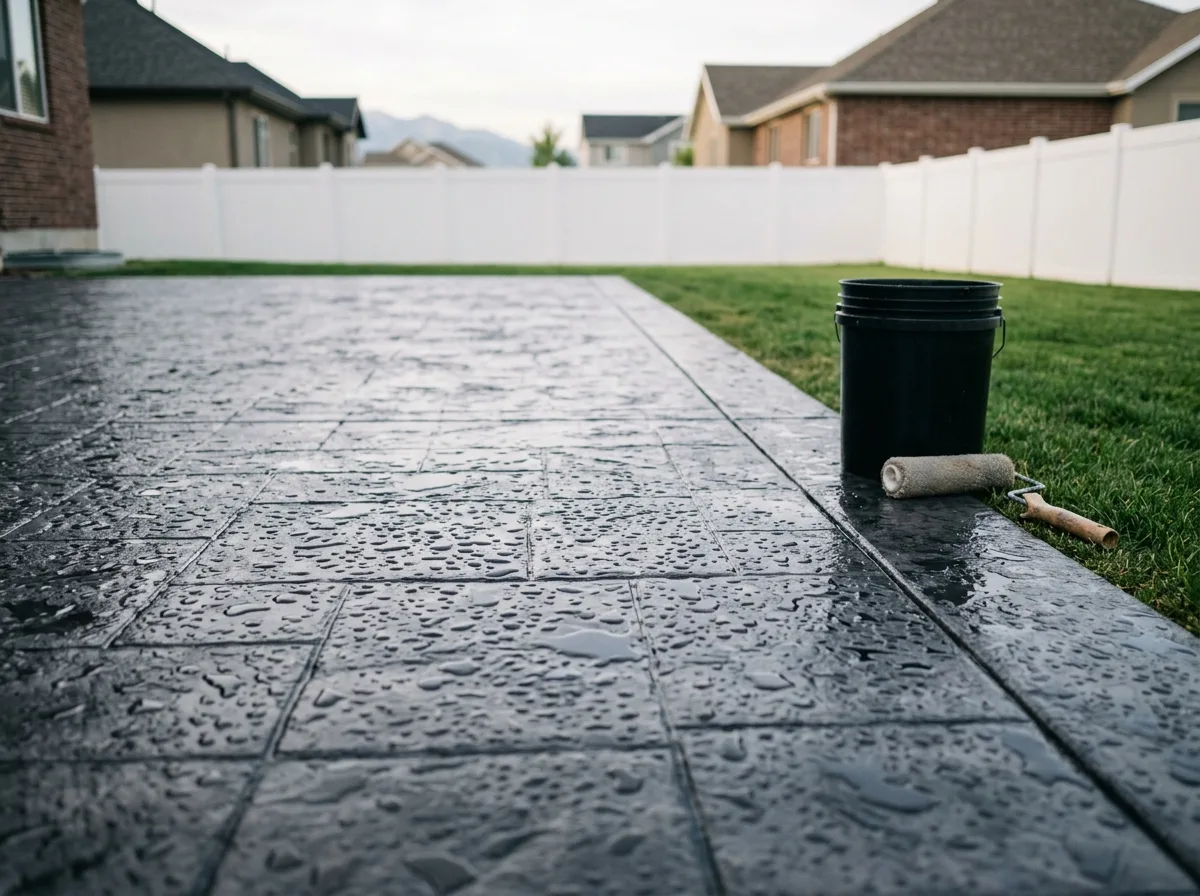
Stamped concrete is almost always sealed, partly for freeze-thaw protection and partly because it keeps the color looking deep and saturated. The mistake is treating more sealer as more protection. A thick film-forming acrylic, especially one built up over several reapplications, can trap moisture inside the slab, and then the sealer itself delaminates in cloudy white sheets after a hard winter.
The safer approach here is a breathable one: a penetrating sealer that soaks in and repels water without forming a skin, or a thin film coat reapplied on a sensible cycle rather than every spring out of habit. Ask which product is going on, and how it is meant to be maintained.
The other half is what you keep off the slab. Chloride deicers accelerate scaling, and rock salt on a new stamped patio in its first winter is the fastest way to ruin it. Shovel instead, and use sand for traction.
Stamped Concrete vs. Pavers in a Freeze-Thaw Climate
This is the real comparison, and it is not lopsided. Pavers are individual units on a flexible base, so ground movement shifts them rather than cracking them, and a damaged one can be lifted and swapped. Stamped concrete is a single slab: faster to install, with no joints for weeds to find, but when it fails it fails as a surface rather than as a piece.
Both work here. Which is right depends on your soil's movement, how much maintenance you want, and how the finished surface needs to look. We went through the cost and durability side of that decision for driveways in concrete versus paver driveways.
When to Pour Matters More Than You Would Think
Timing is a durability decision here, not only a scheduling one. A slab poured in late spring or summer has months of warm, dry weather to cure before it meets its first freeze. One poured late in the autumn may go into winter still holding water, and the first hard cycle hits it at its weakest.
Cold-weather pours are not impossible, and are done routinely with blankets, heated enclosures, and mix adjustments. But the calendar is worth planning around, which we covered in the best time to pour concrete in Utah.
So Is Stamped Concrete Worth It Here?
Yes, with conditions. If the mix suits a freeze-thaw climate, the water drains away instead of standing on the slab, the joints are planned rather than left to chance, and the surface is sealed sensibly and kept clear of rock salt, a stamped patio in Sandy will look the way you pictured it for years. Skip any one of those to hit a lower bid and the failure turns up in the top layer, where it is both most visible and hardest to fix.
So ask specific questions: what is the mix design, where does the water go, where are the joints, and what sealer and maintenance cycle do you recommend. An installer who answers those crisply is telling you a lot.
Installify installs concrete patios and driveways across Salt Lake, Utah, and Davis counties, licensed and insured, and we will beat your best written estimate by $100 or more or send you a $50 Amazon gift card. If you are planning a stamped patio or driveway, call (385) 402-8427 for a free quote and we will walk the space with you.
Frequently asked questions
Does stamped concrete crack more than regular concrete?
No. It is the same concrete, so it cracks for the same reasons: shrinkage, ground movement, and joints placed too far apart. The difference is cosmetic. A crack across a stamped pattern is more noticeable than one across a broom finish, which is why joint placement gets more attention on decorative work.
How often does stamped concrete need resealing in Utah?
It depends entirely on the product. A penetrating sealer may go years between applications, while a film-forming acrylic typically needs redoing every couple of seasons. Resealing on a fixed annual habit is a common way to build up too much film, so go by how the existing sealer is actually performing rather than by the calendar.
Can I use ice melt on a stamped concrete patio?
Avoid chloride-based deicers, especially during the slab's first winter, because they accelerate surface scaling and the damage shows up in the decorative layer. Shovelling promptly and using sand for traction is much kinder to the surface.
Can stamped concrete go over an existing slab?
Sometimes, using a stampable overlay, but only if the slab underneath is sound. An overlay sits on top of whatever is already there, so any existing cracking, scaling, or drainage problem will work its way back through. If the base slab is failing, replacing it is the more durable answer.
How soon can I use a new stamped patio?
Foot traffic is usually fine within a couple of days, and vehicles need considerably longer. Sealing waits until the slab has dried enough to take it. Your installer should give you the specific windows for your pour, since weather at the time changes all of them.


