
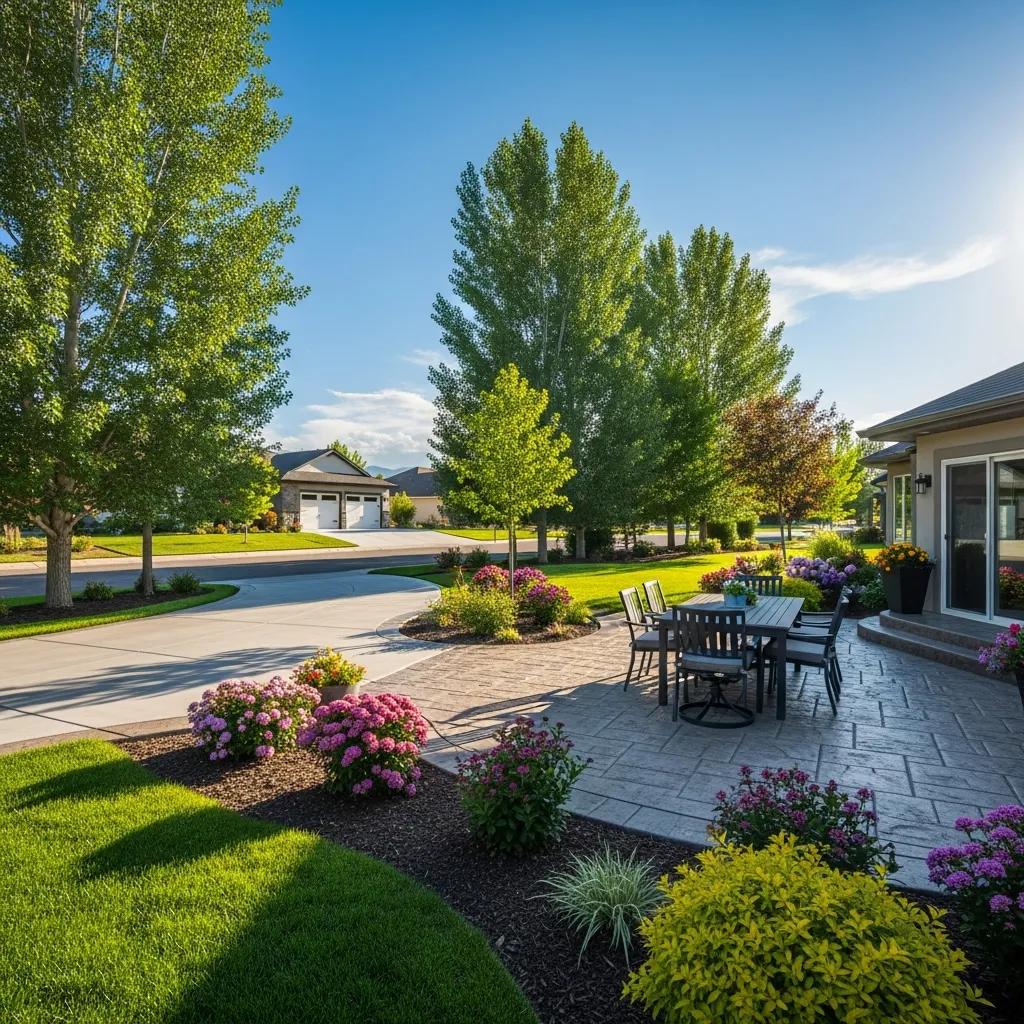
Concrete Patio Installation in Sandy, Utah: What to Know First
A concrete patio looks like the simplest project in the yard: a flat slab outside the back door. In Sandy it is less simple than it looks, because the ground under it freezes, thaws and moves every winter, and a slab poured without allowing for that will show it within a few years.
This guide covers concrete patio installation in Sandy, Utah: what goes under the slab, how it is reinforced, the finishes to choose from, what patios cost across Utah as a market, and when to pour. It is about patios specifically. Driveways follow the same principles with a thicker slab.
Why prep decides how long a Sandy patio lasts
The difference between concrete that lasts and concrete that cracks comes down to work nobody sees once the patio is finished. Sandy's soil is a mix of clay and rock that moves as it wets and dries, and Utah's freeze-thaw cycles punish a weak slab quickly. Every concrete patio we pour is built on four things:
- Excavation and grading. The site is dug out and graded so the finished patio sheds water away from the house instead of toward the foundation.
- A compacted base. Base material is laid and compacted so the slab sits on something that will not settle unevenly.
- Rebar and thickness. A patio is typically 4 inches thick over that base, and every slab we pour is reinforced with rebar.
- Control joints. Joints are placed so that when the slab moves, it cracks along a line that was planned rather than across the middle.

Will a concrete patio crack?
All concrete eventually develops hairline cracks as it cures and shifts with the seasons. That is normal. The aim is to prevent structural cracks, and to keep the small ones in the joints where they never affect the slab. Base, rebar, thickness and joint spacing are what do that, which is why they matter more than anything you can see on the day the patio is finished.
Finish options for a concrete patio
The finish sets both the look of the patio and how the surface behaves when it is wet. There are four common choices:
- Broom finish. A lightly textured, slip-resistant surface. The practical standard, and the easiest to live with outside a back door.
- Stamped concrete. Pressed with a pattern to resemble stone, brick or tile. The highest-end look of the four.
- Exposed aggregate. The stone in the mix is revealed at the surface, which is both decorative and slip-resistant.
- Smooth trowel. A clean, flat surface best kept for covered patios, because it is slick when wet.

A note on stamped concrete
Stamped concrete needs a little more thought here than in a mild climate, because a textured surface gives water more places to sit before it freezes. Drainage, joints and sealing all matter more. Our article on how stamped concrete handles Utah's freeze-thaw explains what keeps it looking good.
What a concrete patio costs in Utah
Concrete flatwork is priced by the square foot, and the finish is the biggest single lever. As general Utah market context, and not an Installify quote:
- Standard poured concrete: roughly $8 to $15 per square foot installed.
- Stamped or colored concrete: roughly $12 to $25 per square foot installed.
What moves a patio's price
Inside those ranges, a specific patio moves with access for equipment, how much excavation and grading the site needs, whether an old slab has to be broken out and hauled away, and the shape. Curves and steps take more forming than a rectangle. If an existing patio is structurally sound but stained or worn, resurfacing it can cost less than a full tear-out, and we will tell you plainly which one your slab needs.
We send a detailed written quote within 24 to 48 hours, and our Best Price Guarantee applies to it: bring us your best written estimate and we will beat it by $100 or more, or send you a $50 Amazon gift card.
The best time to pour a patio in Sandy
Concrete does not dry. It cures through a chemical reaction that prefers moderate, steady temperatures. Along the Wasatch Front that makes late spring and early fall the easiest windows. Summer pours are routine, but they start early in the day and the surface is kept from drying too fast in the heat.
Winter pours are possible with the right precautions. We use heated water in the mix and insulated blankets while the slab cures, and we will not pour if temperatures are forecast to stay below freezing for an extended stretch. Our seasonal guide to the best time to pour concrete in Utah covers each season in detail. Most of our projects are scheduled and started within two weeks, so in the good months the wait is short.
Planning the patio itself
A few decisions are far cheaper to make before the pour than after it:
- Size it for the furniture. Lay out the table, chairs and grill on the lawn, then add room to walk around them. Most regrets about patios are about size.
- Think about the sun. A west-facing patio in Sandy takes the full afternoon heat. If shade is likely to be added later, say so before the pour.
- Say what will sit on it. A hot tub or a shed loads a slab differently from patio chairs, and the slab should be planned for it.
- Watch the water. Note where downspouts empty and where snowmelt runs in spring, so the patio does not end up in the path of either.
Get a concrete patio quote in Sandy
We are based in Sandy and pour patios for homeowners across Sandy's neighborhoods, from Hidden Valley and Bell Canyon to White City and Granite, and across Salt Lake, Utah and Davis counties.
Installify is licensed and insured, and every patio carries a lifetime materials warranty and a 2-year installation warranty. Call (385) 402-8427 or ask for a free quote, and we will give you an exact price for your patio.
Frequently asked questions
How thick should a concrete patio be?
Patios are typically 4 inches thick over a compacted base. Every slab we pour is reinforced with rebar regardless of thickness.
Will my concrete patio crack?
All concrete eventually develops hairline cracks as it cures and shifts with the seasons. Proper base prep, rebar, correct thickness and well-placed control joints keep those cracks small and in the joints, and prevent structural cracks.
Can you pour a concrete patio in winter in Utah?
Yes, with the right precautions. We use heated water in the mix and insulated blankets while the slab cures, and we will not pour if temperatures are forecast to stay below freezing for an extended stretch. Spring through fall is ideal.
How much does a concrete patio cost in Sandy, Utah?
As general Utah market context, standard poured concrete runs roughly $8 to $15 per square foot installed, and stamped or colored concrete roughly $12 to $25. Those are market ranges, not a quote. Your price depends on size, site prep, finish and access.
Can an old concrete patio be resurfaced instead of replaced?
Yes. If the existing slab is structurally sound but cracked, stained or worn, we can resurface it instead of pouring new concrete. If the slab is past saving, we will tell you.
What warranty comes with an Installify patio?
Every patio carries a lifetime materials warranty and a 2-year installation warranty.


