
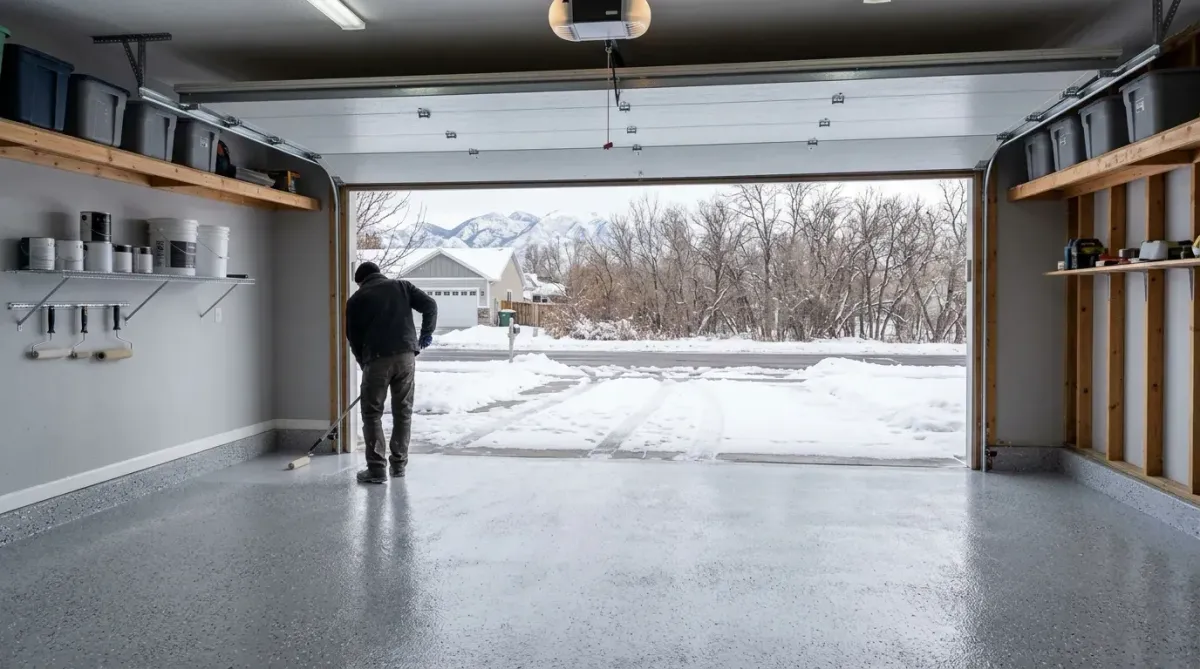
Can You Epoxy a Garage Floor in Winter in Utah?
By February most garage floors along the Wasatch Front have taken a beating the rest of the house never sees. Snow packed into the wheel wells melts onto the slab and brings road brine and magnesium chloride with it. The salt sits in the pores, water freezes and expands overnight in an unheated garage, and by March the floor is dusting, pitting and stained in the two strips where the tires sit. Plenty of homeowners here in Sandy want that dealt with in January rather than June.
So can you epoxy a garage floor in winter in Utah? Usually yes, and it is one of the few improvements our winter does not simply stop. But it turns on one number almost nobody checks, and getting it wrong is how a floor peels inside its first year.
The number that matters is the slab, not the air
Coating manufacturers do not care what the thermometer on the garage wall says. They specify the temperature of the concrete itself. Most standard epoxy systems want the slab around 55 to 60 degrees and rising, and a few degrees above the dew point so moisture is not condensing on the surface as the coating goes down.
A slab is a large block of thermal mass sitting on cold ground, and it lags the air by days rather than hours. An unheated garage in Sandy or Draper can reach 55 degrees on a mild February afternoon while the slab underneath sits in the low forties. Warming the air for an hour changes the reading on the wall and nothing else.
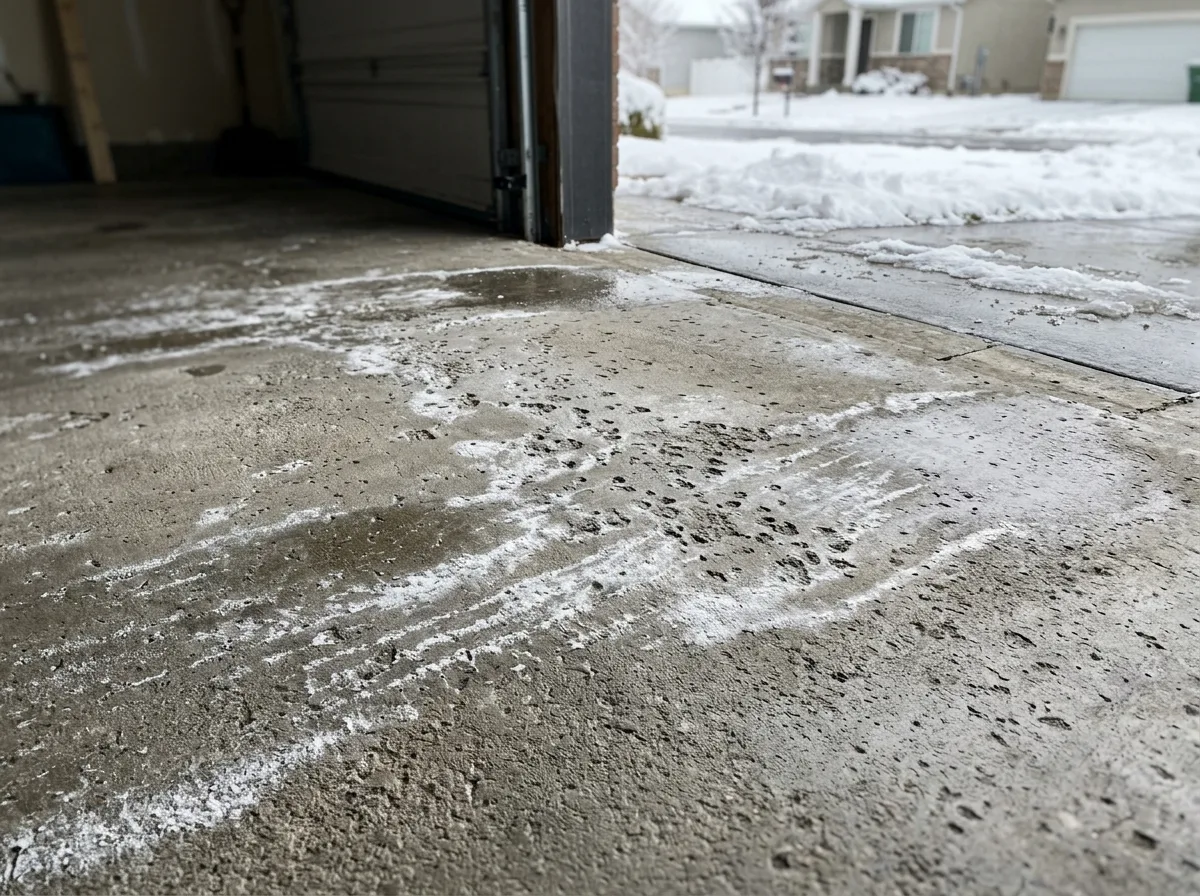
What cold does to a coating that goes down anyway
A coating applied to a cold slab rarely fails on the day. It fails quietly, over the following months, in four ways.
- It stops flowing. Cold epoxy thickens like cold honey and will not self-level, so roller lines, thick edges and thin patches stay exactly where they were laid.
- The cure stretches out. Cure time roughly doubles for every 18 degrees you drop. A coat that is walkable overnight at 70 degrees can still be soft three days later in the forties.
- Blush. Cold, damp air on curing epoxy leaves a waxy haze on the surface. You cannot always see it, and the next coat will not stick to it.
- Adhesion. A slab below spec never lets the resin key into the ground concrete, and that is the difference between a floor that lasts and one that lifts in sheets.
What a Utah winter will not let you do
This is the part worth hearing before anyone takes a deposit. Some winter jobs should not happen, and heating the space harder is not the way around it.
- An open-flame heater makes it worse. A kerosene or propane salamander pumps water vapor and combustion gas into the room, which is exactly what causes blush and ambering.
- A wet slab cannot be coated at all. Cars drag snow in and the floor stays damp for hours. Drying a cold slab is measured in days, not an afternoon with a fan.
- New concrete still waits its 28 days, and cold weather pushes that out rather than in. A slab poured in November is not ready in December.
- A coating does not undo salt damage. Brine already in the pores has to be washed out and ground off, and spalled concrete needs repairing first. Coat over it and the problem is sealed in.
- A crack that is still moving stays moving. Freeze-thaw works on a slab all winter. A crack can be repaired properly, but not hidden under a film.
How long before you can park on it?
This is the question that decides whether a winter install fits your life, because the garage is out of use for the whole window. A standard epoxy system needs about a day before foot traffic and five to seven days before a vehicle goes back on it. A polyaspartic system is much faster, often walkable overnight and drivable inside a day or two.
In a cold garage, add to both of those, and do not shorten them. Parking early causes hot tire pickup, where warm tires lift a coating that has not fully hardened and take a print of the tread with them. For what each system runs, our guide to what an epoxy garage floor costs in Utah has the ranges, and those are market context rather than a quote for your slab.
Why winter can genuinely be the right time here
There is a real argument for going ahead now. A garage is the one part of a Utah property that can be brought up to temperature and held there. A driveway, a patio and a deck all have to wait for spring; the garage does not.
It is also the season the damage is happening. A floor coated in February stops soaking up brine in February rather than after one more winter of it.
How Installify handles a winter garage floor
We measure the slab, not the room: an infrared reading off the concrete itself, a dew point check, and a moisture test before we commit to a date. A slab pushing vapor up from the ground will reject a coating no matter how warm the garage feels.
Prep is diamond grinding rather than acid etching, which matters more in winter than at any other time of year, since etching has to be rinsed and dried and a cold slab will not dry. Where the temperature calls for it we use a polyaspartic system, which cures colder and far faster than standard epoxy, and we bring the slab up with indirect, vented heat rather than an open flame. Our epoxy and polyaspartic garage floor coatings carry a lifetime materials warranty and a 2-year installation warranty, and we are licensed and insured.
And if the conditions in your garage are not right, we say so and book you for spring rather than taking the job and hoping. A floor that peels in April costs more than the wait did.
Get a Real Number for Your Garage
Every garage is a different slab with a different history, and the only way to know whether yours can be coated this month is to look at it. Call (385) 402-8427 or get a free quote and we'll beat your best written estimate by $100 or more, guaranteed, or you get a $50 Amazon gift card.
Frequently asked questions
Can you epoxy a garage floor in winter in Utah?
Usually yes. A garage is one of the few spaces that can be brought up to temperature and held there through a Wasatch Front winter. What decides it is the slab temperature, and whether the concrete is dry and sound.
What temperature does epoxy need to cure?
Most standard epoxy systems want the concrete around 55 to 60 degrees and rising, and a few degrees above the dew point. That is the slab temperature, not the air, and in an unheated Utah garage the two can be more than ten degrees apart.
Can I just run a heater in the garage to make it work?
Not an open-flame one. Kerosene and propane salamanders release water vapor and combustion gas into the space, which causes blush and ambering in a curing coating. Indirect, vented heat brought up over a day or two is the right approach.
How long before I can park on a new epoxy floor?
Roughly a day for foot traffic and five to seven days for a vehicle on a standard epoxy system, and faster on polyaspartic. A cold garage adds to both. Parking early causes hot tire pickup, where warm tires lift the coating.
Is polyaspartic better than epoxy for a winter install?
For cold-weather work, yes. Polyaspartic cures at lower temperatures and much faster, and resists road salt and UV better. Many Utah garages get a hybrid: an epoxy base coat for build, finished with a polyaspartic topcoat.
Should I just wait until spring?
Sometimes. If the slab was poured in the last 28 days, is damp, or has salt damage needing repair first, waiting is right. Otherwise a winter coating stops the brine soaking in for one more season.


