
How to Choose a Stamped Concrete Contractor in Sandy, Utah
Choosing a stamped concrete contractor in Sandy
Search for a stamped concrete contractor in Sandy, Utah and most of the first page is directories and "top 10" lists. They tell you who has the most reviews. They do not tell you whose stamped patio will still have its color and its pattern after a few Wasatch Front winters.
Stamped concrete is ordinary concrete with a decorative texture pressed into the top while it is still workable. So a contractor has to get two things right: the slab underneath and the finish on top. The first is the same as any concrete job. The second is a craft of its own, done against the clock. This guide covers the questions that separate a crew that does both well from one that does not, and what a good answer sounds like.
Look at stamped work they have actually done
Start with the basics. Utah licenses contractors through the Division of Professional Licensing (DOPL), and its public search takes a couple of minutes. Ask for proof of current liability insurance too. Our general guide to choosing a concrete contractor in Sandy covers the license, base and rebar questions in more detail, so this one focuses on what is different about stamped work.
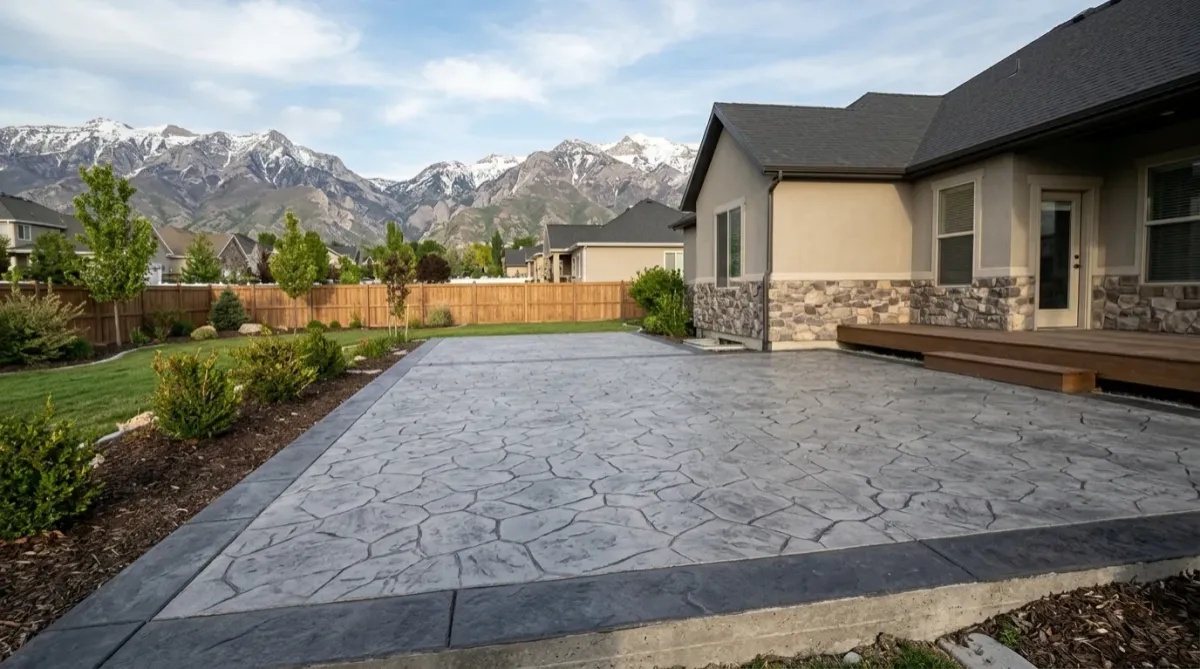
Then look at real jobs, not just a gallery. Photos online are chosen and well lit. Ask for photos or addresses of stamped patios, walkways or driveways that are at least a few years old, ideally close enough to drive past. When you look, check for:
- A pattern that lines up across the whole slab, with no doubled impressions or smeared spots where the mats overlapped.
- Even color, without blotches or a washed-out patch in the middle.
- Crisp edges and borders.
- No flaking, where the surface has lifted and gray concrete shows through the color.
Ask how big the crew is on pour day
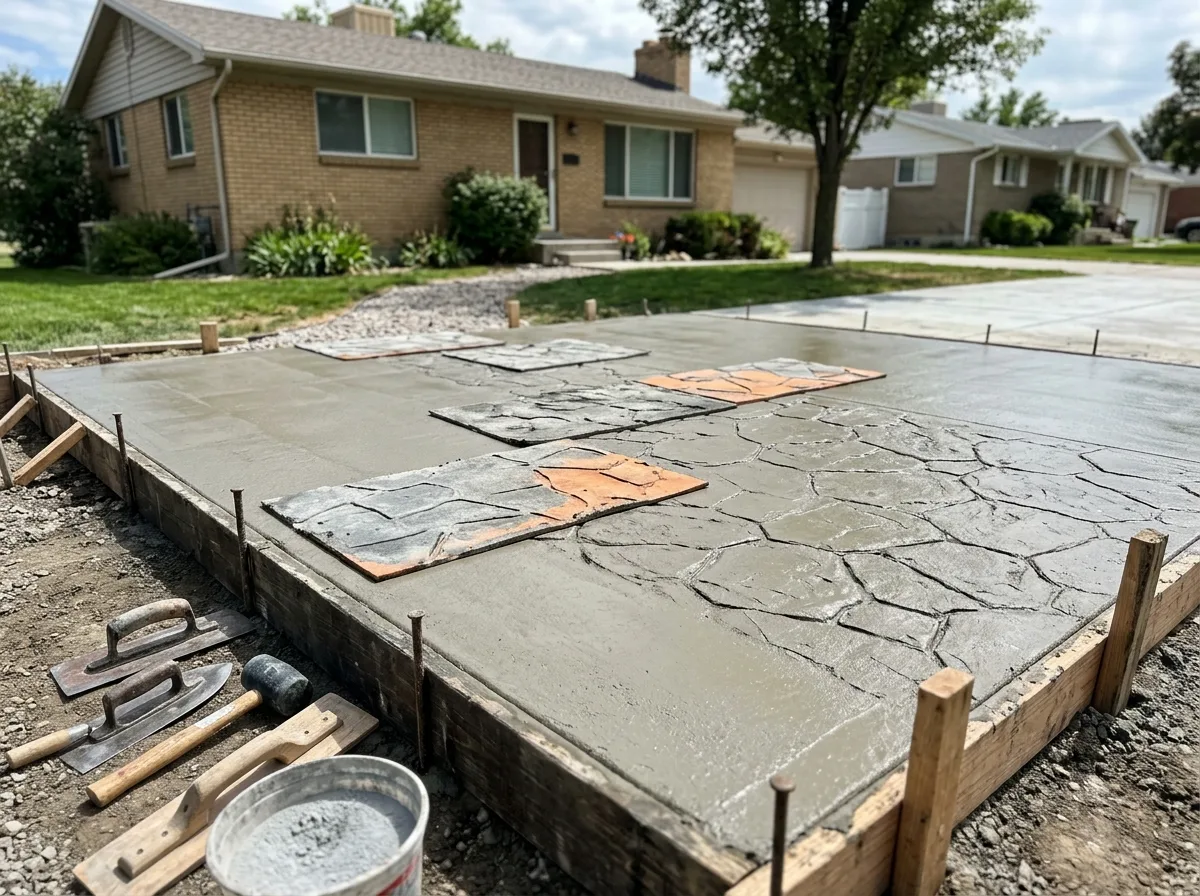
Stamping is a race. Once concrete is placed it starts to set, and the texture mats have to go down when the surface is firm enough to hold a pattern but still soft enough to take one. Too early and the pattern slumps. Too late and it tears or barely shows.
A large patio needs enough hands to pour, finish, apply color and stamp the whole slab inside that window, and a hot summer afternoon shortens it. Ask how many people will be on site and how they handle a big area: one continuous pour, or sections broken at planned joints. A contractor who has a clear answer has done this before.
Ask how the color goes in
Color usually comes from one or more of three things: pigment mixed through the whole batch, a color hardener spread over the fresh surface, and a release agent that keeps the mats from sticking and leaves a second, darker tone in the low spots of the texture.
Ask which they use and why. Color mixed through the batch runs all the way through the slab, so a chip or scrape shows less. Surface color gives stronger, richer tones but lives in the top layer. A good contractor will show you physical samples rather than a phone screen, and will tell you plainly that the finished slab can vary a little from a sample, because every batch and every pour day is slightly different.
Ask where the control joints will go
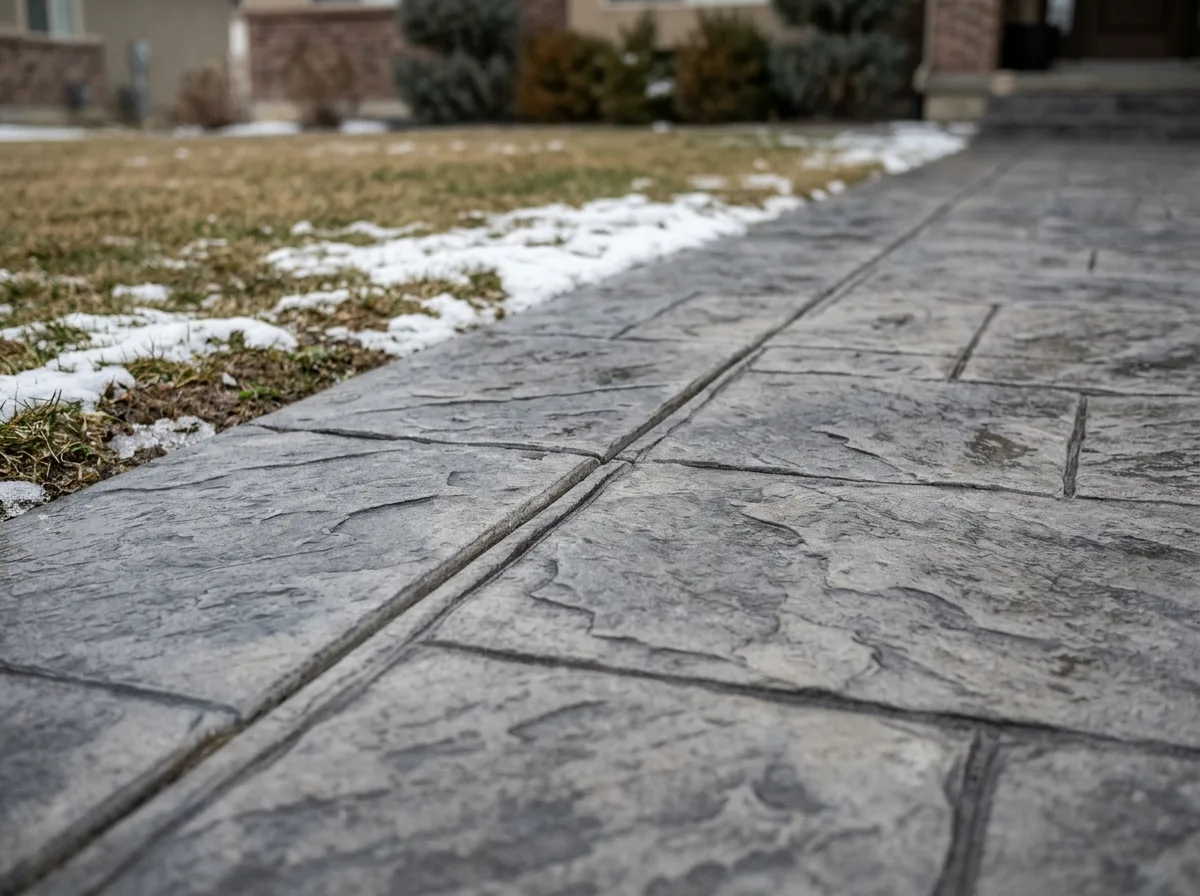
All concrete cracks a little; control joints decide where. On a plain broom-finish slab a cut line is unremarkable. Across a flagstone or slate pattern, a joint in the wrong place looks like a scar. Experienced stamping crews plan the joints so they fall along the pattern's own grout lines, where they almost disappear. Ask to see the joint layout before the pour, on the same sketch that shows the pattern and any border.
Under the pattern it is still a slab, and the slab is what keeps the pattern flat. Ask how the site is excavated and graded, how the base is compacted, how thick the slab will be and how it is reinforced. On our concrete patios and driveways every slab gets rebar regardless of thickness, stamped or not.
Ask what they do about freeze-thaw and sealing
Utah winters attack the top of a slab first, and on stamped concrete that is exactly where the color and texture live. Ask what mix they order for exterior work in a freeze-thaw climate and how the slab will be sloped so snowmelt runs off instead of sitting in the grooves of the pattern.
Then ask which sealer goes on. A sealer that builds a thick film can trap moisture and turn cloudy or peel after a hard winter. A good contractor will tell you what product they use, when it should be redone and how you will know it is time. Ask about de-icers as well, because rock salt on a new stamped slab in its first winter is a fast way to lose the surface. Our article on how stamped concrete handles Utah freeze-thaw goes deeper on all of this.
Get a written quote that names the finish
"Stamped patio, 400 square feet" is not a quote you can compare. A useful one spells out excavation and base, thickness and reinforcement, the pattern, how the color goes in and which colors, any border or accent, the sealer, haul-off of an old slab and cleanup. When two bids name the same things you can compare them fairly. When one leaves out the color method or the sealer, that is where a surprise charge tends to come from later.
If you already have a slab that is sound but worn, ask whether resurfacing it with a stamped finish could work instead of tearing it out. An honest contractor will tell you which one your concrete actually needs.
Red flags worth walking away from
Any one of these is reason enough to get another bid:
- No license number, or reluctance to show insurance.
- No finished stamped work you can see.
- A one-line price with no pattern, color method or sealer named.
- No clear answer on joint placement or sealing.
- A large cash deposit before anything is scheduled, or pressure to sign today.
Stamped concrete for Sandy homes
Sandy lots run from flat valley yards near White City to sloped foothill lots toward Bell Canyon, where drainage and grading take more planning before a decorative slab goes in. A crew that knows the difference will talk about where the water goes before it talks about patterns. Our Sandy service page lists the neighborhoods we work in.
Installify is based in Sandy and pours stamped patios, walkways and driveways across Salt Lake, Utah and Davis counties. We are licensed and insured, every project carries a lifetime materials warranty and a 2-year installation warranty, and we will beat your best written estimate by $100 or more, or send you a $50 Amazon gift card. Call (385) 402-8427 for a free quote and we will walk the space with you.
Frequently asked questions
How long does stamped concrete last in Utah?
Stamped concrete can last for decades here when the mix suits a freeze-thaw climate, water drains off the slab, the control joints are planned and the surface is sealed sensibly and kept clear of rock salt. Skipping any of those usually shows up first as flaking in the decorative top layer.
Is stamped concrete slippery?
A sealed stamped surface can be slicker than a broom finish when it is wet or icy. Ask your contractor about patterns with deeper texture for walkways and steps, or a slip-resistant additive in the sealer.
Can stamped concrete go over an existing patio?
Sometimes. If the existing slab is structurally sound, it can often be resurfaced with a stamped finish instead of being torn out. If it is cracked through, sinking or draining badly, replacing it is the more durable answer.
What stamped concrete patterns are most common?
Flagstone, slate, ashlar (cut stone), cobblestone and wood plank are the patterns most homeowners choose, often with a contrasting border. Ask to see a sample of the pattern and color together before you decide.
How soon can I walk on a new stamped patio?
Foot traffic is usually fine within a couple of days, and vehicles on a stamped driveway need considerably longer. Sealing waits until the slab has dried enough to take it. Your contractor should give you the exact windows for your pour, since the weather changes all of them.


